REVIEW · DUBLIN
Celebrate Every Love Story
Book on Viator →Operated by Fabrice Jolivet · Bookable on Viator
If your phone is your only camera, this fixes that. You’ll get a professional couples’ photography session in Dublin’s most iconic spots while also getting short, useful context about what you’re standing in front of. It’s built for milestones, including LGBT-friendly sessions, and you’ll leave with professionally shot portraits—not blurry “we were moving” souvenirs.
I like that the session is private and focused. You’re not herded with strangers, and you’ll get direction for posing so you can stop thinking and start looking natural. Another big win: you download at least 30 portraits within days, with some guests reporting digital copies in about 3–4 days.
One consideration: this experience runs on the street, and it requires good weather. If it rains or conditions are poor, you’ll need to reschedule (or get a full refund), so plan it with flexibility in mind.
In This Review
- Quick hits before you go
- Meeting at Stags Head: where your Dublin photo walk starts
- What you’re really paying for: pro portraits in 60 minutes
- Dublin Castle stop: history you can photograph (and actually use)
- City Hall stop: refined architecture for portraits that feel classic
- Temple Bar / nightlife area: the Dublin mood shot
- Ha’penny Bridge: the story behind the shots
- LGBT-friendly sessions: making your love story the center
- How the posing and guidance makes photos look natural
- Getting your portraits: downloads you can use fast
- Price and logistics: value for couples who want less hassle
- Who this fits best (and who might skip it)
- Should you book Celebrate Every Love Story in Dublin?
- FAQ
- How long is the couples photo session?
- How many photos will we receive?
- How soon will the digital photos be available?
- Is this a private tour or do we share with other people?
- What landmarks are included?
- What happens if the weather is bad?
Quick hits before you go
- Private couples session for up to 2 people, so the time stays personal
- 30+ professionally shot portraits delivered digitally within days
- Iconic backdrops: Dublin Castle, City Hall, Ha’penny Bridge, and Dublin’s nightlife area
- Fast turnaround (many guests report 3–4 days for digital copies)
- Directional posing help so you don’t spend the hour doing awkward selfies
- English-language experience with a pro photographer, Fabrice Jolivet
Meeting at Stags Head: where your Dublin photo walk starts
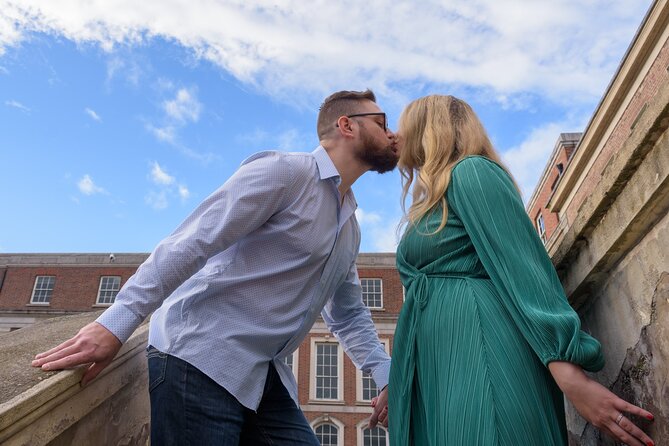
Your session begins at the Stags Head, 1 Dame Ct, Dublin (D02 TW84). That matters more than it sounds. Starting near a recognizable spot helps you avoid the classic travel problem of standing around checking maps while the light changes.
From there, the pace feels like a light city walk with purposeful stops. You’re going to be guided to specific angles and positions rather than just “go stand by that building.” This is why a dedicated photographer session is worth it: you’re buying time and direction, not just access to views.
Also, you’ll be working with Fabrice Jolivet (often referred to as Fab in the session style). Across the experience, the vibe is part photo coaching, part mini city storytelling. If you freeze when a stranger asks you to pose, you’ll probably relax quickly—the whole setup is built to make it feel natural.
You can also read our reviews of more tours and experiences in Dublin.
What you’re really paying for: pro portraits in 60 minutes
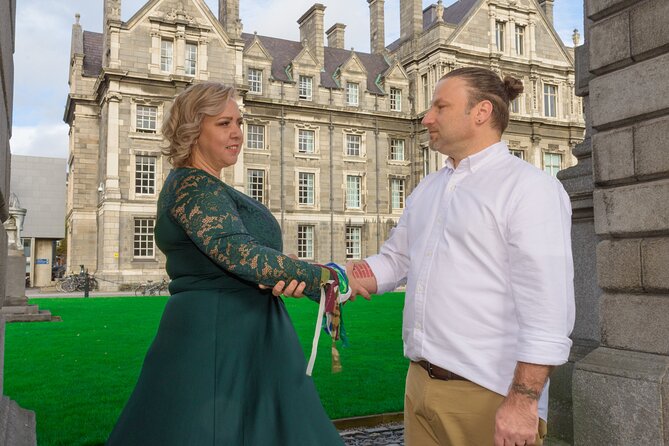
The price is about $156.03 per group (up to 2) for roughly one hour. On paper, that’s not the same as a free walking tour. But here’s the value math that tends to click for couples:
- You get at least 30 professional portraits (not a handful)
- You’ll receive them as a download, so you don’t have to wait for prints
- You get this in a timeframe that’s often within days, with some guests seeing 3–4 days
- You’re not spending your vacation time managing camera settings, framing, or trade-offs like “one of us has to hold the camera”
You’re buying a clean, low-stress souvenir. The best part is that you’re not just collecting pictures—you’re also getting ones that match the moment: anniversaries, honeymoons, and other special occasions. Many couples book specifically because they want their relationship documented in a way that looks like it belongs in an album, not a camera roll.
Dublin Castle stop: history you can photograph (and actually use)
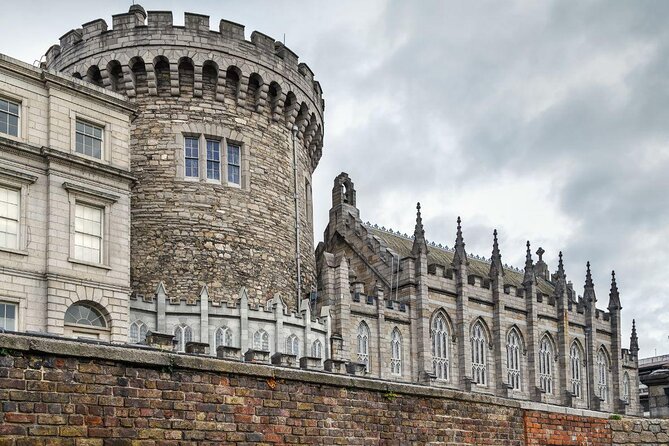
One of your first major photo settings is Dublin Castle. It’s a site with serious layers: originally erected in the early 13th century on a Viking settlement footprint, it later served as the headquarters for English—and later British—administration in Ireland. After independence in 1922, it moved into the hands of the new Irish government and today it’s both a key government complex and a top attraction.
Why this stop works for photos:
- The buildings give you strong structure—arches, stone textures, and dramatic angles.
- It’s a place where “standing somewhere pretty” turns into “standing somewhere meaningful.” Even if you don’t study the past, your photos still feel grounded in the city.
- The courtyard and perimeter areas naturally offer different backgrounds, so you can get variety without changing locations nonstop.
What to consider: this is a major visitor area. You’ll want to follow your photographer’s lead on where to stand and when to shift for better angles. Expect some positioning changes as you move from one look to another.
City Hall stop: refined architecture for portraits that feel classic
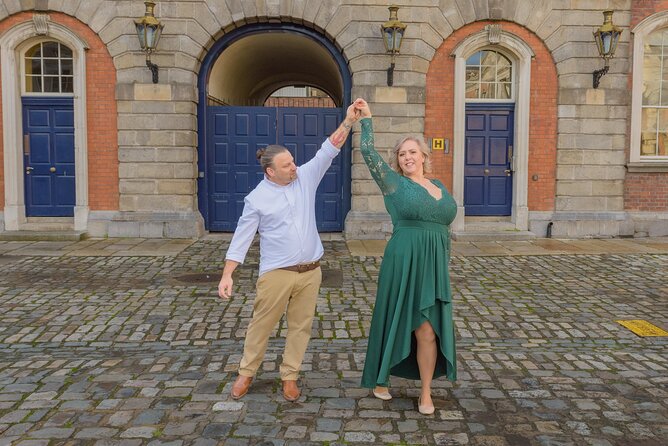
Next up is Dublin City Hall, built between 1769 and 1779. Construction took ten years, and the design came from a competition with 62 submissions. The winning architect was Thomas Cooley, who was relatively young at the time. Later, Thomas Cooley was also tendered to build the Four Courts, but he fell ill and died at 44—so James Gandon became the primary architect for that project.
In a photo session, City Hall is valuable because it’s the opposite of “street chaos.” It’s cleaner and more formal. That helps if you want your images to feel timeless rather than trendy.
Practical tip for getting better results: listen for the photographer’s direction on posture and spacing. At architectural stops like this, small changes in where you stand and how you angle your bodies can make a big difference between “we’re in front of a building” and “we’re part of the building’s frame.”
Temple Bar / nightlife area: the Dublin mood shot
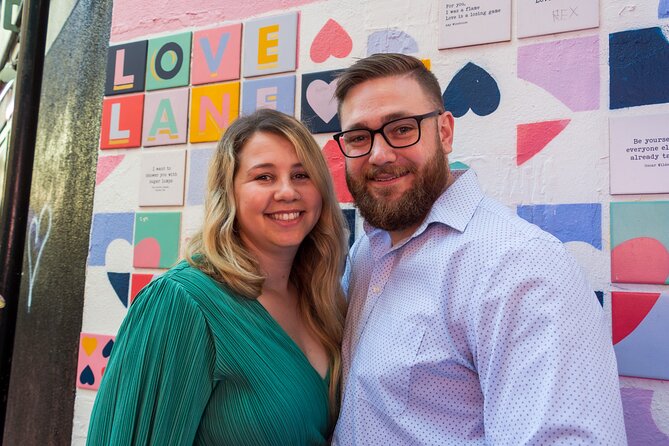
One part of the walk is the area described as the heart of Dublin’s nightlife. In practice, this often lines up with the Temple Bar zone, and it’s a smart choice for couples who want photos that feel like Dublin, not just Dublin buildings.
Why this stop is useful:
- You get a livelier street-energy backdrop.
- Nightlife neighborhoods tend to create more human texture in the background, which can make portraits feel less posed and more story-like.
- It helps break up the session so you’re not stuck only on historic stone.
A consideration here: nightlife areas can be busy depending on the time of day. If the sidewalks are crowded, you’ll likely do more repositioning. That’s normal—and it’s also why having a photographer who knows where to stand helps. You won’t be guessing, and you won’t waste time arguing with your phone.
Ha’penny Bridge: the story behind the shots
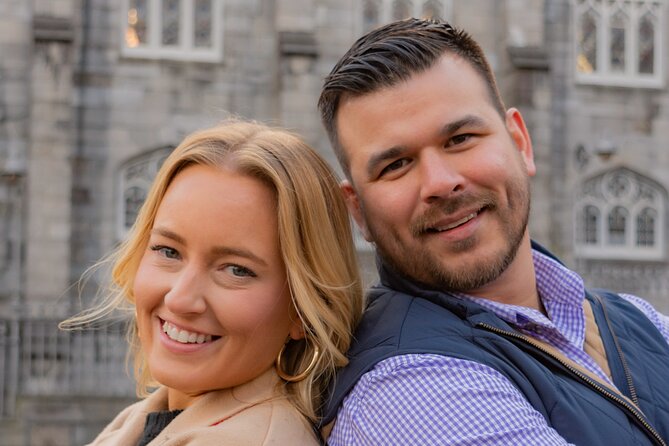
You’ll also spend time around Ha’penny Bridge, which has one of the most fun local stories in the area. Before the bridge existed, there were seven ferries across the River Liffey, operated by William Walsh. The ferries were in bad condition, and Walsh was told he either had to fix them or build a bridge.
He chose the bridge option and was granted the right to charge a ha’penny toll for 100 years. The toll started based on what the replaced ferries charged, not on construction cost. There was also a civic condition: if locals found the bridge and toll objectionable within the first year, it could be removed at no cost to the city. Later, the toll was briefly increased to a penny-ha’penny (1½ pence) and eventually dropped in 1919. While the toll existed, turnstiles stood at either end of the bridge.
For your photos, this stop works because:
- You get a clear focal point with the bridge structure and river context.
- The spot makes sense as a “final chapter” of the walk: it ties the session to Dublin’s real-life river geography.
- The story gives your photographer an excuse to point out what to watch for—angles, river lines, and how to frame you with the bridge.
If you’re the type who gets self-conscious at bridges (most people do), remember: your photographer is there to place you. The session includes posing guidance, so you’re not left standing there thinking, now what?
LGBT-friendly sessions: making your love story the center
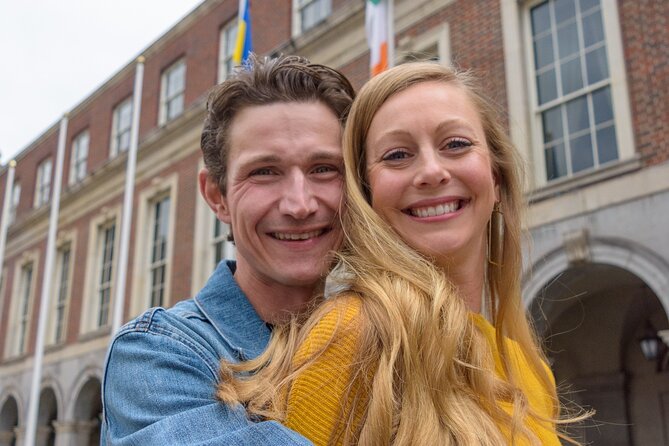
This experience is designed to welcome LGBT-friendly photography sessions, which matters for something simple: comfort. When you feel relaxed, your body language reads better on camera. And when your session is framed around your relationship (not around a stereotype of how couples “should” look), you get photos that feel like you.
Across the session style, couples consistently mention feeling comfortable during posing. That’s the hidden magic trick. A good photographer doesn’t just shoot; they help you act natural while you’re being photographed.
If you want portraits that you’ll actually print or use for cards, that comfort piece is not a small detail. It changes everything.
How the posing and guidance makes photos look natural
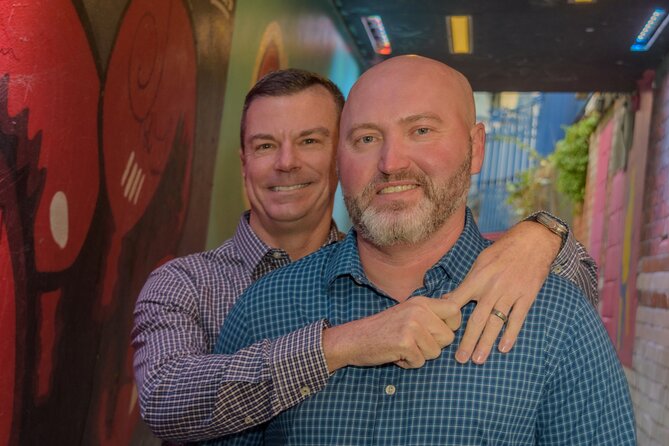
One of the most repeated themes in the experience is how Fabrice helps couples feel comfortable and how he guides you into position. That’s huge if you don’t like selfies. Instead of you trying to figure out camera angles, you’re given simple direction and timing cues—where to stand, how to face, and how to move so you don’t look stiff.
You can also expect a mix of:
- Posing help (so you’re not guessing)
- Short site context as you move between landmark stops, which gives your session a sense of flow
- A playful, personable attitude that keeps the hour from feeling like an assignment
If you’ve ever tried to take couple photos yourself, you already know the problem: one person is always awkwardly holding the phone while the other half tries to pose without looking at the screen. Here, that entire tension disappears.
Getting your portraits: downloads you can use fast
At the end of the session, you’ll be able to download at least 30 professionally shot portraits within days. Some guests report seeing digital copies in 3–4 days, which is a solid turnaround for a trip souvenir you can actually enjoy while you’re still in the mood.
Practical advice: once you receive the images, pick your favorites quickly. Don’t overthink it. If the photos are professionally shot, you’ll usually find a handful that are automatically usable for prints, holiday cards, or even making a little album page.
Also, because the session aims for multiple landmarks, you’ll likely have variety: formal stone architecture, a river/bridge setting, and street mood shots. That variety makes it easier to choose images that fit different uses.
Price and logistics: value for couples who want less hassle
Let’s talk money and time in plain terms. You’re paying for:
- A private session for up to 2 people
- A real pro photographer (Fabrice Jolivet)
- Enough portraits to give you options later (30+)
- Delivery within days, often quickly
At $156.03 per group, the cost can feel steep compared to “just walk around Dublin.” But it doesn’t compete with that. It complements it. If you want one part of your trip to be photo-ready without stress, this is an efficient way to do it.
Logistics-wise, the meeting point is fixed, and the session is around one hour. That timing is perfect for a day when you also want time to explore Temple Bar streets, do a museum, or just wander.
Two considerations to keep in mind:
- You need good weather, since the session is outdoors around major landmarks.
- You’ll be actively posing and moving—so this works best if you’re comfortable being guided and focused for an hour.
Who this fits best (and who might skip it)
This is an easy yes if:
- You’re celebrating a milestone like a honeymoon or anniversary
- You want photos that look professional without doing technical camera work
- You don’t like selfies and want help that makes posing easier
- You want variety across iconic Dublin landmarks in a short window
You might hesitate if:
- You hate being told what to do for photos (the hour is guided)
- Your schedule is inflexible and you can’t handle a weather-related reschedule
If you’re planning a trip where time is tight and you want one “memory payoff” moment, this is one of the most straightforward ways to get it.
Should you book Celebrate Every Love Story in Dublin?
If your goal is to leave Dublin with real couple portraits—not a few decent snaps—this is a smart booking. The biggest reasons are the clear deliverable (30+ portraits) and the fact that the session is private and guided, so you don’t lose the best light wrestling with a phone.
Book it if you want a structured walk through Dublin Castle, City Hall, and the Ha’penny Bridge area, with a nightlife stop that adds Dublin street mood. Skip it only if you’re likely to be miserable in outdoor, guided posing, or you can’t handle a weather-dependent plan.
If that sounds like you, go for it. Your future self will be grateful when you’re actually holding photos you love.
FAQ
How long is the couples photo session?
It lasts about 1 hour (approx.).
How many photos will we receive?
You’ll be able to download at least 30 professionally-shot portraits within days.
How soon will the digital photos be available?
The experience states within days, and some guests reported receiving digital copies in about 3–4 days.
Is this a private tour or do we share with other people?
It’s private. Only your group participates.
What landmarks are included?
The session includes photo stops around Dublin Castle, Dublin City Hall, the Ha’penny Bridge area, and Dublin’s nightlife area.
What happens if the weather is bad?
The experience requires good weather. If it’s canceled due to poor weather, you’ll be offered a different date or a full refund.